一、实验室负责人 Laboratory Director
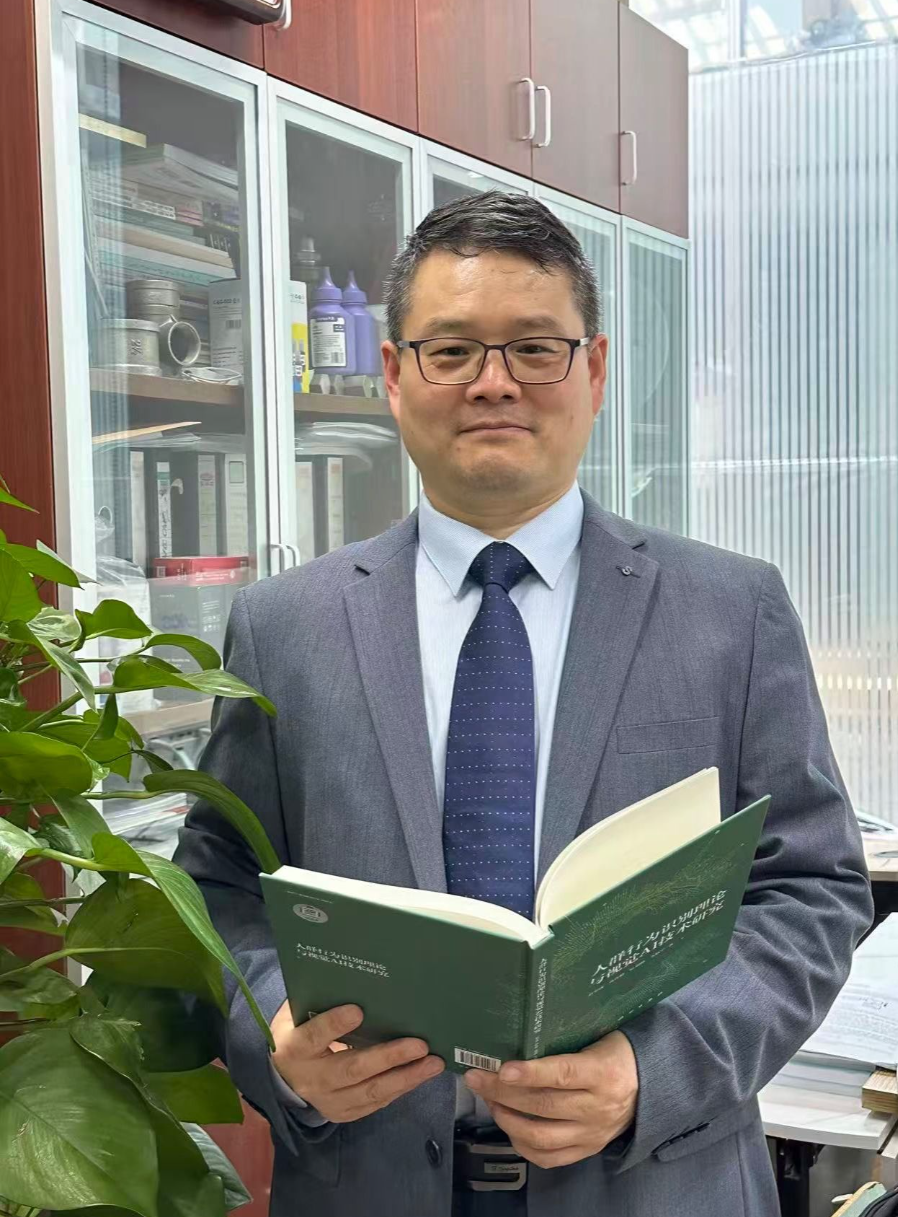
赵荣泳,博士,长聘副教授,博士生导师,同济大学电子与信息工程学院CIMS研究中心。2005年获得同济大学控制理论与控制工程专业博士学位。上海市国产大飞机安全生产数字化转型技术服务基地首席科学家,国际电气和电子工程师协会IEEE Member,中国人工智能学会粒计算与知识发现专业委员会委员。
Rongyong Zhao, Ph.D., tenured Associate Professor and doctoral supervisor at the CIMS Research Center, School of Electronics and Information Engineering, Tongji University. He received his Ph.D. in Control Theory and Control Engineering from Tongji University in 2005. He is Chief Scientist of the Shanghai Technology Service Base for the Digital Transformation of Safe Production of Domestically Produced Large Aircraft, a member of the Institute of Electrical and Electronics Engineers (IEEE), and a member of the Granular Computing and Knowledge Discovery Technical Committee of the Chinese Association for Artificial Intelligence.
主要研究方向:计算机视觉、人工智能理论,应用领域:公共安全、智能制造;主持国家自然基金项目3项、上海市自然基金项目1项、上海市重大研究计划项目1项、参与国家自然基金重大计划项目1项、重点项目1项、国家科技攻关项目2项、上海市科技创新项目12项,上海市信息化项目6项。获得教育部科技进步奖二等奖1项,上海市科技进步奖三等奖1项,上海市优秀产学研项目三等奖1项。发表学术论文及专著107篇(SCI收录16篇,EI收录43篇)。主编专著《城市大型活动人群动力学建模与稳定性控制》和《UWB定位技术及智能制造应用》、参编学术专著2本,授权发明专利18项、实用新型专利1项、软件著作权37项。
His main research interests include computer vision and artificial intelligence theory, with applications in public safety and intelligent manufacturing. He has led three National Natural Science Foundation of China (NSFC) projects, one Shanghai Natural Science Foundation project, and one Shanghai Major Research Plan project. He has also participated in one NSFC Major Research Plan project, one NSFC Key Program project, two national key technology research projects, 12 Shanghai science and technology innovation projects, and six Shanghai informatization projects. His honors include one Second Prize of the Ministry of Education Science and Technology Progress Award, one Third Prize of the Shanghai Science and Technology Progress Award, and one Third Prize for Outstanding Industry–University–Research Collaboration Projects in Shanghai. He has published 107 academic papers and scholarly works, including 16 papers indexed by SCI and 43 by EI. He is the lead editor of Crowd Dynamics Modeling and Stability Control for Large Urban Events and UWB Positioning Technology and Applications in Intelligent Manufacturing, and a contributing author of two other academic monographs. He holds 18 granted invention patents, one utility model patent, and 37 software copyrights.
二、拟招聘研究生研究方向及课题 Research Areas and Topics for Prospective Graduate Students
1. 城市空间大模型与跨模态智能感知(硕/博)Large Models for Urban Spaces and Cross-Modal Intelligent Perception (Master's/Ph.D.)
研究核心: 针对高密度城市枢纽、景区等复杂场景,研究视觉大模型(VLM)与多模态大模型(MLLM)在客流态势感知中的应用。
Research focus: Investigate the applications of large vision models (VLMs) and multimodal large language models (MLLMs) in passenger-flow situational awareness in complex settings such as high-density urban transport hubs and scenic areas.
课题内容:研发基于Prompt引导的异常行为零样本(Zero-shot)识别算法。构建融合视频、信令、舆情及低空无人机数据的跨模态时空知识图谱。探索长序列客流预测的Transformer变体模型及其在极端天气/突发事件下的鲁棒性。
Research topics: Develop prompt-guided algorithms for zero-shot recognition of abnormal behavior. Build cross-modal spatiotemporal knowledge graphs integrating video, signaling, public-opinion, and low-altitude drone data. Explore Transformer variants for long-sequence passenger-flow forecasting and their robustness under extreme weather and emergency events.
2. 具身智能与人形机器人安全行为调控(硕/博)Embodied Intelligence and Safety-Oriented Behavior Regulation for Humanoid Robots (Master's/Ph.D.)
研究核心: 聚焦人机共存场景下的安全性评价与风险干预。
Research focus: Focus on safety assessment and risk intervention in environments where humans and robots coexist.
课题内容:研究基于时空图卷积网络(ST-GCN)与强化学习的人机交互风险演化模型。开发面向具身智能的异常动作实时检测(如跌倒、越界、非规范交互)算法研究基于数字孪生技术的机器人运动规划安全边界验证与实时闭环优化。
Research topics: Investigate models of risk evolution in human–robot interaction based on spatiotemporal graph convolutional networks (ST-GCNs) and reinforcement learning. Develop real-time algorithms for detecting abnormal actions in embodied intelligence systems, such as falls, boundary violations, and noncompliant interactions. Investigate digital-twin-based verification of safety boundaries in robot motion planning and real-time closed-loop optimization.
3. 生成式AI驱动的城市动力学仿真与决策(硕/博)Generative AI-Driven Urban Dynamics Simulation and Decision-Making (Master's/Ph.D.)
研究核心: 利用生成式AI突破传统人群模拟的参数标定瓶颈。
Research focus: Use generative AI to overcome parameter-calibration bottlenecks in conventional crowd simulation.
课题内容:利用扩散模型(Diffusion Model)生成高保真的人群异常聚集与扰动扩散场景,解决长尾样本匮乏问题。研究大语言模型(LLM)驱动的智能决策Agent,实现自然语言指令到城市管控策略的自动化映射。行人动力学机理模型与数据驱动深度学习模型的深度融合(Physics-informed AI)。
Research topics: Use diffusion models to generate high-fidelity scenarios of abnormal crowd gathering and disturbance propagation, addressing the scarcity of long-tail samples. Investigate intelligent decision-making agents driven by large language models (LLMs) to automatically map natural-language instructions to urban management and control strategies. Integrate mechanistic pedestrian dynamics models with data-driven deep learning models through physics-informed AI.
4. 工业大脑与大型装备生产安全管控(硕/博)Industrial Intelligence and Production Safety Management for Large-Scale Equipment (Master's/Ph.D.)
研究核心: 面向国产大飞机等重大工程,构建工业场景下的“感知-决策”闭环。
Research focus: Develop a closed-loop perception–decision-making framework for industrial environments, targeting major engineering projects such as domestically produced large aircraft.
课题内容:研究基于UWB高精度定位与SLAM融合的生产要素全域智能追踪技术。开发复杂生产车间内人员作业规范性判别与隐患自动识别视觉系统。面向智能制造调度的自适应演化算法研究。
Research topics: Investigate intelligent, site-wide tracking of production resources by integrating high-precision UWB positioning with SLAM. Develop vision systems for assessing worker compliance with operating procedures and automatically identifying hazards in complex production workshops. Investigate adaptive evolutionary algorithms for intelligent manufacturing scheduling.
三、申请条件 Application Requirements
1. 基本要求Basic Requirements
自动化、人工智能、计算机、数学、统计、交通工程、测绘等相关专业背景。
An academic background in automation, artificial intelligence, computer science, mathematics, statistics, transportation engineering, surveying and mapping, or a related discipline.
具备扎实的数学功底(线性代数、概率论、最优化方法等)。
A solid foundation in mathematics, including linear algebra, probability theory, and optimization methods.
具有良好的英语文献阅读与学术论文撰写能力。
Good English-language skills for reading academic literature and writing research papers.
2. 能力加分项Preferred Qualifications
编程功底: 精通Python、C++或MATLAB,熟悉PyTorch、TensorFlow等深度学习框架。
Programming skills: Proficiency in Python, C++, or MATLAB, and familiarity with deep learning frameworks such as PyTorch and TensorFlow.
科研经历: 有过相关领域的竞赛获奖、项目参与经历,或已发表/在投高水平学术论文(SCI/EI收录优先)。
Research experience: Awards in relevant competitions, participation in research projects, or high-quality academic papers that have been published or are under submission; SCI/EI-indexed publications are preferred.
3. 素质要求Personal Qualities
对科研有浓厚兴趣,具备独立思考能力和抗压能力。
A strong interest in research, independent thinking skills, and the ability to work under pressure.
具有团队协作精神,能够协助导师指导实验室低年级本科生进行科创实践。
A collaborative mindset and the ability to assist the supervisor in mentoring junior undergraduate students in the laboratory on science and technology innovation projects.
四、实验室支持与培养 Laboratory Support and Training
一流平台: 提供高性能计算服务器及充足的科研经费。
First-class facilities: Access to high-performance computing servers and ample research funding.
产学研结合: 实验室与商飞、上海申铁等头部企业及政府部门有紧密合作,提供丰富的实战数据源与落地场景。
Industry–university–research collaboration: The laboratory works closely with leading enterprises, including COMAC and Shanghai Shentie, as well as government departments, providing extensive real-world data sources and practical application settings.
学术交流: 支持研究生参加国内外高水平学术会议,优秀博士生可推荐至海外顶尖名校联合培养。
Academic exchange: Support for graduate students to attend leading academic conferences in China and abroad. Outstanding doctoral students may be recommended for joint training at top overseas universities.
五、申请方式 How to Apply
准备材料: * 个人简历(包含学习经历、GPA排名、科研成果列表、技能证书等)。代表性成果证明(如论文PDF、获奖证书扫描件、GitHub项目链接等)。简短的个人研究计划(Research Statement,可选)。
Application materials: A CV including educational background, GPA and ranking, research outputs, and skills certificates; evidence of representative achievements, such as paper PDFs, scanned award certificates, and GitHub project links; and a brief research statement (optional).
邮件投递:发送至:zhaorongyong@tongji.edu.cn邮件标题格式:“硕/博申请-本科院校-专业-姓名-研究方向”。
Email submission: Send your application to zhaorongyong@tongji.edu.cn. Use the following email subject format: "Master's/Ph.D. Application–Undergraduate Institution–Major–Name–Research Area".
审核流程: 实验室将对申请材料进行初步筛选,并通知符合条件的同学进行面试。
Selection process: The laboratory will conduct an initial review of application materials and invite eligible applicants for interviews.
实验室诚邀志同道合的你,在公共安全与AI交叉的前沿阵地,共同攻克关键技术挑战!
We warmly welcome like-minded applicants to join us at the forefront of public safety and AI and work together to tackle key technological challenges!

