

大模型智能体
一、方向简介
随着大语言模型与多模态基础模型的快速发展,人工智能正由以信息生成与问答为主的应用模式,向面向复杂任务环境的自主执行与智能协同方向演进。面对开放环境中任务结构复杂、决策过程动态变化以及外部信息高度不确定等问题,传统单一模型驱动的智能系统在任务理解、连续推理与执行能力方面仍存在明显局限,难以满足高复杂度应用场景的需求。
本研究方向面向复杂开放环境中的智能决策问题,围绕“任务理解—规划决策—协同执行”全过程,综合运用大语言模型、多模态感知建模、知识增强推理与智能决策优化等技术,构建以大模型智能体为核心的自主执行与协同交互框架。通过融合环境感知、语义理解、动态记忆与行为决策机制,形成数据驱动与模型驱动相结合的智能体理论体系与关键技术,实现复杂任务的自主解析、动态规划与高效执行,推动智能系统由“生成式响应”向“自主式决策与执行”转变。
I. Introduction to the Direction
With the rapid development of large language models and multimodal foundation models, artificial intelligence is evolving from application modes centered on information generation and question answering toward autonomous execution and intelligent collaboration for complex task environments. Faced with issues such as complex task structures, dynamically changing decision-making processes, and highly uncertain external information in open environments, traditional intelligent systems driven by a single model still have significant limitations in task understanding, continuous reasoning, and execution capabilities, making it difficult to meet the demands of highly complex application scenarios.
This research direction focuses on intelligent decision-making in complex open environments and covers the entire process of “task understanding—planning and decision-making—collaborative execution.” It comprehensively applies technologies such as large language models, multimodal perception modeling, knowledge-enhanced reasoning, and intelligent decision-making optimization to build an autonomous execution and collaborative interaction framework centered on large model agents. By integrating environmental perception, semantic understanding, dynamic memory, and behavioral decision-making mechanisms, an intelligent agent theoretical framework and key technologies that combine data-driven and model-driven approaches are developed, enabling autonomous analysis, dynamic planning, and efficient execution of complex tasks, and promoting the transformation of intelligent systems from “generative response” to “autonomous decision-making and execution.”
二、研究内容
II. Research Content
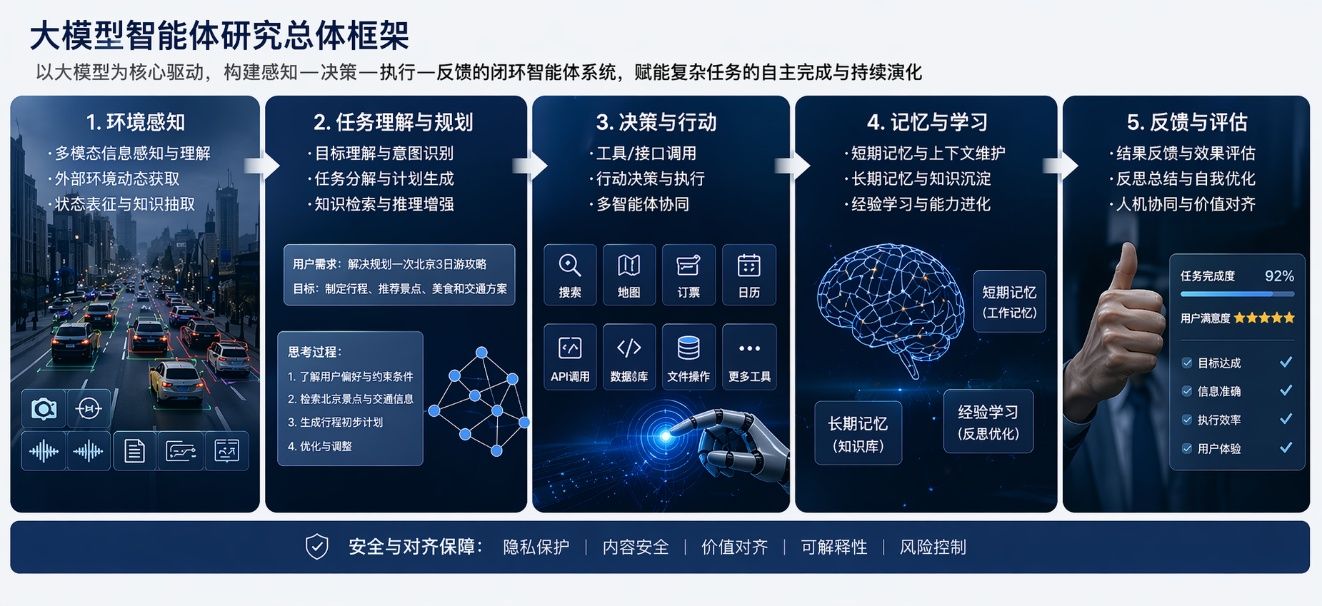
大模型智能体研究总体框架
Overall Research Framework for Large Model Agents
大模型智能体任务理解与自主决策
面向复杂任务环境中需求多样、结构动态变化的问题,融合多模态输入信息与任务上下文数据,开展基于大模型智能体的任务理解与自主决策研究。通过构建面向任务解析与决策生成的统一模型,实现复杂任务语义解析、任务分解与执行路径规划,为智能体自主执行提供基础支撑。
Task Understanding and Autonomous Decision-Making for Large Model Agents
Addressing the diverse requirements and dynamically changing structures in complex task environments, research is conducted on task understanding and autonomous decision-making based on large model agents by integrating multimodal input information and task context data. By constructing a unified model for task parsing and decision generation, complex task semantic parsing, task decomposition, and execution path planning are achieved, providing fundamental support for autonomous execution by intelligent agents.
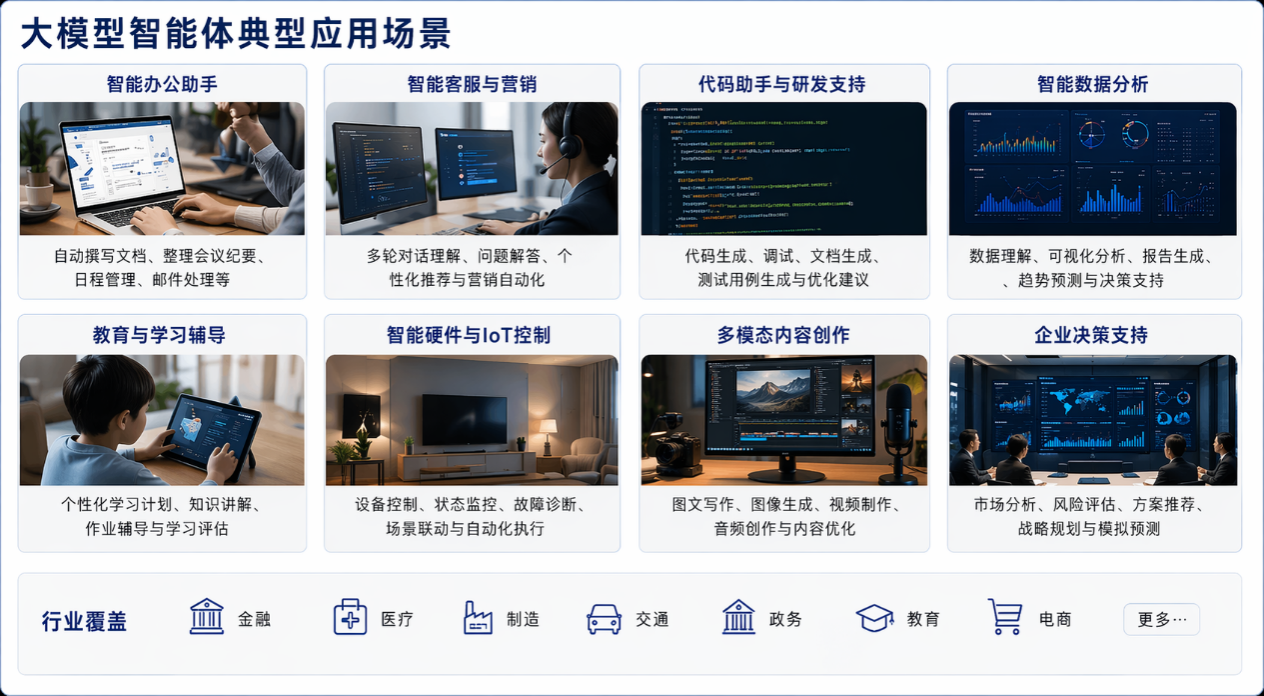
大模型智能体典型应用场景
Typical Application Scenarios of Large Model Agents
课题组围绕智能体任务处理中的理解与决策问题,重点研究基于大模型的任务建模与推理方法。针对复杂任务存在语义不明确、步骤依赖性强等问题,引入大语言模型与多模态模型,构建任务语义表示与推理框架,实现任务目标与执行约束的统一建模;同时结合知识增强推理与上下文记忆机制,对任务执行过程进行动态优化。进一步通过任务规划与决策生成机制,建立智能体自主决策模型,实现复杂任务的自动分解与路径优化。
The research group focuses on understanding and decision-making in agent task processing, with an emphasis on large model-based task modeling and reasoning methods. To address issues such as ambiguous semantics and strong step dependencies in complex tasks, large language models and multimodal models are introduced to construct a task semantic representation and reasoning framework, achieving unified modeling of task objectives and execution constraints; meanwhile, knowledge-enhanced reasoning and contextual memory mechanisms are incorporated to dynamically optimize the task execution process. Furthermore, through task planning and decision generation mechanisms, an autonomous decision-making model for intelligent agents is established, enabling automatic decomposition and path optimization of complex tasks.
大模型智能体协同交互与智能决策优化
面向复杂系统中多任务协同与动态交互需求,结合多智能体系统与外部工具资源,开展智能体协同交互与决策优化研究。通过构建多智能体协同与工具调用机制,实现任务执行过程中的信息共享、协同推理与动态决策优化,为复杂任务处理提供系统化支持。
Collaborative Interaction and Intelligent Decision-Making Optimization for Large Model Agents
Addressing the requirements for multi-task collaboration and dynamic interaction in complex systems, research is conducted on agent collaborative interaction and decision-making optimization by integrating multi-agent systems and external tool resources. By constructing multi-agent collaboration and tool-calling mechanisms, information sharing, collaborative reasoning, and dynamic decision-making optimization are achieved throughout the task execution process, providing systematic support for complex task processing.
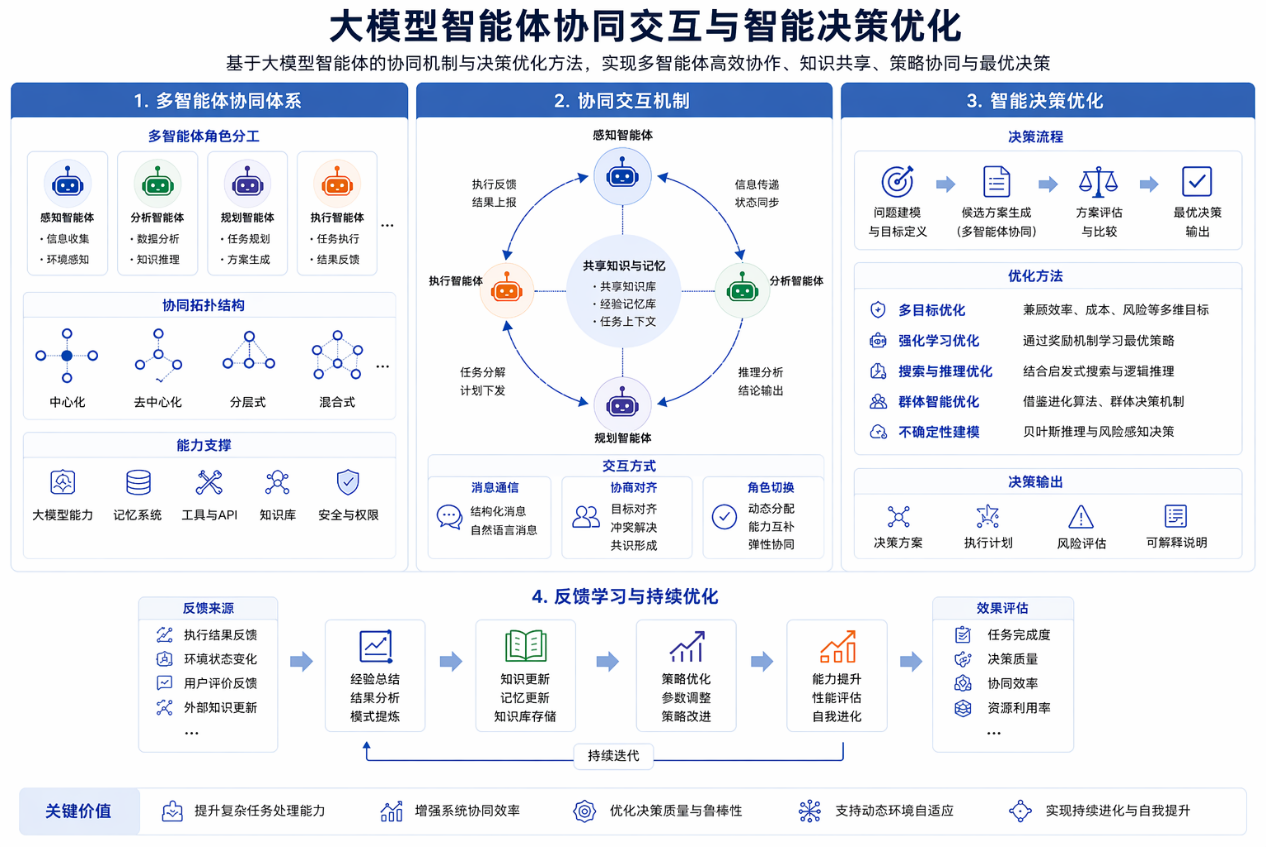
大模型智能体典型应用场景
Typical Application Scenarios of Large Model Agents
课题组围绕智能体系统中的协同与优化问题,重点研究多智能体交互与决策机制。针对复杂环境中单一智能体能力受限的问题,引入多智能体协同框架,实现任务分工与协同执行;同时结合外部工具调用与环境反馈机制,对任务执行过程进行动态调整。进一步通过策略优化与反馈学习机制,建立智能体协同决策模型,实现复杂任务的高效执行与持续优化,并通过约束机制与结果验证方法提升系统的安全性与可靠性。
The research group focuses on collaboration and optimization in agent systems, with an emphasis on multi-agent interaction and decision-making mechanisms. To address the limitations of individual agents in complex environments, a multi-agent collaboration framework is introduced to achieve task allocation and collaborative execution; meanwhile, external tool-calling and environmental feedback mechanisms are integrated to dynamically adjust the task execution process. Furthermore, through policy optimization and feedback learning mechanisms, a collaborative decision-making model for agents is established to achieve efficient execution and continuous optimization of complex tasks, while improving system safety and reliability through constraint mechanisms and result verification methods.