一、方向简介
机器人行为安全研究聚焦机器人在开放环境、自主作业和人机协同过程中的安全行为约束与风险控制问题,旨在提升机器人系统运行的可靠性、可验证性和可控性。该方向重点研究机器人在感知误差、环境不确定、任务冲突和系统异常等条件下的安全决策机制,包括行为规划安全、运动控制安全、人机交互安全、异常状态识别、故障诊断与应急处置等内容。通过融合控制理论、形式化验证、强化学习、安全规则建模与可解释人工智能方法,构建覆盖“感知—决策—执行—反馈”的行为安全保障体系。相关研究可服务于巡检机器人、服务机器人、工业机器人和无人系统等应用场景,有助于降低失控、碰撞、误操作和协同失效等风险,为机器人在复杂现实环境中的规模化应用提供基础保障。
I. Introduction to the Direction
Robot behavioral safety research focuses on safety behavior constraints and risk control for robots operating in open environments, autonomous operations, and human-robot collaboration, aiming to improve the reliability, verifiability, and controllability of robot systems. This direction focuses on safety decision-making mechanisms for robots under conditions such as perception errors, environmental uncertainty, task conflicts, and system anomalies, including behavior planning safety, motion control safety, human-robot interaction safety, abnormal state recognition, fault diagnosis, and emergency response. By integrating control theory, formal verification, reinforcement learning, safety rule modeling, and explainable artificial intelligence methods, a behavioral safety assurance system covering “perception—decision-making—execution—feedback” is developed. The related research can serve application scenarios such as inspection robots, service robots, industrial robots, and unmanned systems, helping reduce risks such as loss of control, collisions, operational errors, and collaborative failures, and providing fundamental support for the large-scale application of robots in complex real-world environments.
二、研究内容与成果
机器人跌倒检测
针对机器人在运行过程中可能出现的姿态失衡、侧翻和倒地等异常情况,开展基于视觉感知与骨架序列分析的跌倒检测研究。通过提取机器人连续动作中的关键点变化信息,建立跌倒行为识别模型,实现对机器人跌倒过程的自动检测与异常预警,提高机器人运行状态监测的实时性和准确性。
II. Research Content and Achievements
Robot Fall Detection
Research on fall detection based on visual perception and skeleton sequence analysis has been conducted to address abnormal conditions that may occur during robot operation, such as postural imbalance, overturning, and falling. By extracting key-point change information from the robot’s continuous movements, a fall behavior recognition model is established to enable automatic detection and anomaly warning during robot falls, improving the real-time performance and accuracy of robot operational status monitoring.
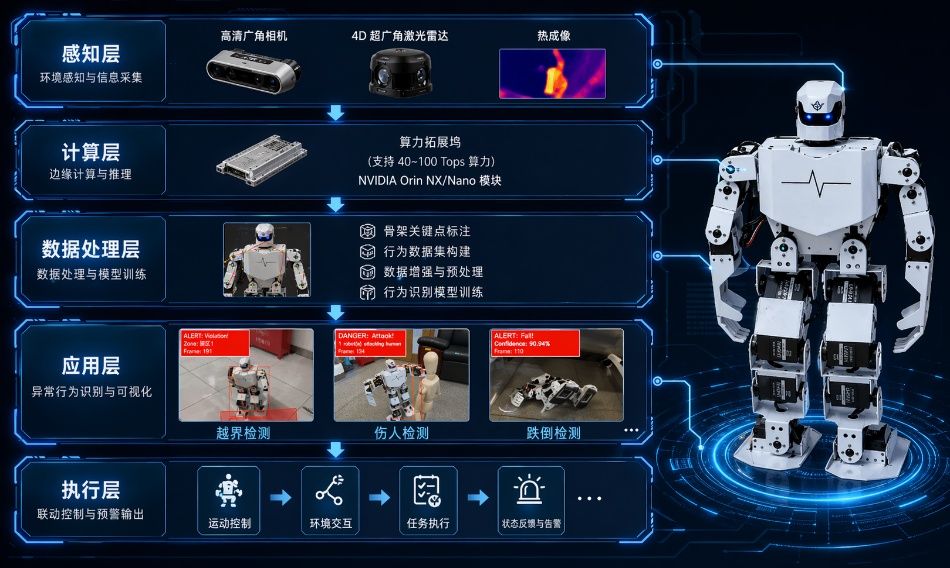
机器人行为安全研究示意图
Schematic Diagram of Robot Behavioral Safety Research
机器人伤人检测
面向机器人与人体近距离交互场景,开展机器人伤人行为检测研究。通过分析机器人与人体之间的相对位置关系、关键部位运动状态及危险动作特征,实现对潜在碰撞、击打和危险接触行为的识别。该研究可为人机协作场景下的安全防护和风险预警提供技术支持。
Robot Injury Detection
Research on robot injury behavior detection is conducted for close-range interaction scenarios between robots and humans. By analyzing the relative positional relationship between the robot and the human, the motion states of key body parts, and the characteristics of dangerous movements, potential collisions, strikes, and dangerous contact behaviors can be identified. This research can provide technical support for safety protection and risk warning in human-robot collaboration scenarios.
机器人越界检测
针对机器人运行区域管理需求,开展机器人越界检测研究。通过设定安全边界区域并结合目标运动状态分析,实现对机器人是否进入限制区域或超出预设活动范围的自动判别。当检测到越界行为时,系统可及时发出告警信息,从而提升实验室和实际应用场景中的安全监管能力。
Robot Boundary Violation Detection
Research on robot boundary violation detection is conducted to address the need for managing robot operating areas. By defining safe boundary regions and combining them with analysis of the robot’s motion state, the system can automatically determine whether a robot has entered a restricted area or exceeded its predefined operating range. When boundary violation behavior is detected, the system can promptly issue an alert, thereby improving safety supervision capabilities in laboratories and practical application scenarios.

